
AI Strategy
Why 95% of enterprise AI pilots produce zero P&L impact.


A close reading of the MIT NANDA report — and what it actually tells us about the failure mode shared by every stalled AI deployment we've seen.

Every company wants to adopt AI. Most can't — and the reason isn't what you'd guess from reading the headlines. The MIT NANDA report published earlier this year laid out a number that's been circulating in boardrooms ever since: 95% of enterprise generative AI pilots produce no measurable P&L impact. The instinct is to blame model quality, or vendor selection, or "change management." None of those are wrong, exactly. But none of them are the actual failure mode.
Here's what we've seen, working inside dozens of operationally complex businesses: the AI step is almost never where projects fail. The step before it is.
An AI agent is, in the most literal sense, a system that follows instructions. To do useful work, it needs a precise description of the workflow it's meant to execute — what triggers it, what happens at each step, what the exceptions are, which systems it touches, what counts as success. That's an instruction set. It's what an agent runs on.
Almost no company has this. What they have instead are workflows that evolved over years inside inboxes, spreadsheets, and tribal knowledge. The person who knew how the order-intake process really worked left two years ago. The new hire learned it by shadowing someone who learned it by guessing. The Confluence page is from 2019 and it's wrong in ways nobody has time to fix.
When you hand that to an agent, the agent fails. Not because the model is bad — because the instructions don't exist.
You can't automate a workflow nobody can describe.AI doesn't change that — it makes it worse, because the failure happens faster and at greater scale.
The companies we've seen succeed share one thing in common: they fixed the prerequisite first. Before they tried to automate anything, they did the unglamorous work of capturing how their workflows actually operate — not how the documentation says, not how the senior PM describes it in a meeting, but how it actually runs at the operator level.
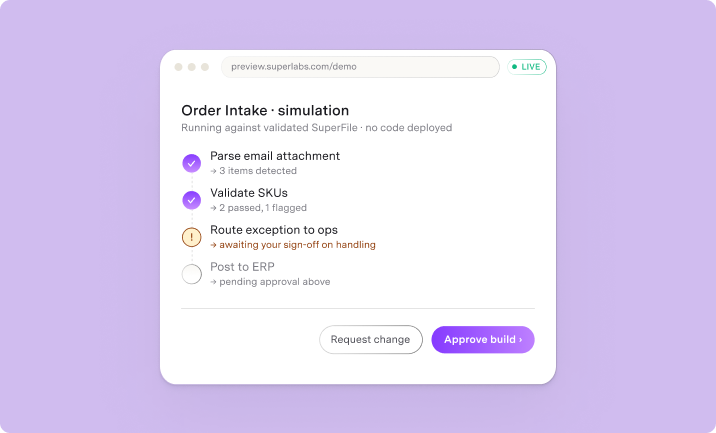
The technology to do this exists now in a way it didn't five years ago. Desktop recorders capture screen activity, audio narration, and system-level logs simultaneously. Pattern-matching models can synthesize across multiple recordings to surface the variations and shortcuts no single person could fully articulate. The output is a structured, machine-readable representation of the workflow — what we call a SuperFile — that an AI agent can actually execute against.
This sounds technical. It's not, really. The shift is conceptual: stop asking people to describe their work and start observing it. Build automation downstream of an evidence-based description, not an aspirational one.
The 95% number is going to keep being cited for years. People will use it to argue against AI investment, or to argue for different vendors, or to argue for slower rollouts. All of those arguments miss the point.
The 95% isn't a problem with AI. It's a problem with the prerequisite to AI. The companies in the 5% aren't using better models — they're operating on better instructions. Until the instructions exist, automation is theater. Once they exist, the rest is execution.

Table of contents


.png)
.png)